FAQ rich results are gone, but FAQ content is not dead
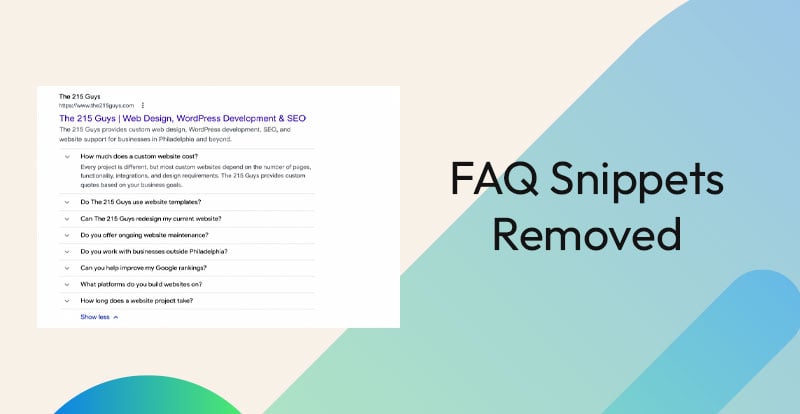
Google officially removed FAQ rich results from search results for almost all websites on May 7, 2026. That means the familiar dropdown FAQ snippets that used to appear under organic listings are no longer showing in the SERPs. This is not just another visibility reduction like we saw in 2023. It is the final removal of FAQ rich results as a search feature for nearly all sites.
The most important thing I would want a site owner to remember is this: FAQ schema is still good to have because it still helps robots understand the information on the page better. The visible rich result benefit is gone, but the structured data itself is not harmful and it can still support machine understanding.
That distinction matters. A lot of site owners hear “FAQ rich results are removed” and immediately assume “FAQ schema is useless.” That is not the right takeaway. The search result enhancement is gone. The content format and the structured context can still be useful.
What changed on May 7, 2026
As of May 7, 2026, FAQ rich results stopped appearing in Google Search results for almost all websites. Before this, Google had already reduced FAQ rich result visibility in 2023, limiting the feature primarily to certain authoritative government and health websites. The 2026 update goes further because the feature is now removed broadly, including for sites that may have still qualified under previous restrictions.
There are also two follow-up changes site owners should know about:
- June 2026: Google Search Console will remove reporting and validation for FAQ structured data.
- August 2026: API support for FAQ rich results will be removed.
These reporting changes are important because they affect how teams monitor structured data. If your SEO dashboard or automated reporting includes FAQ rich result validation, those reports will eventually stop being useful or may need to be removed from your workflow. That does not mean your pages are broken. It means Google is retiring support for that rich result type in its reporting systems.
What FAQ snippets actually did before they were removed
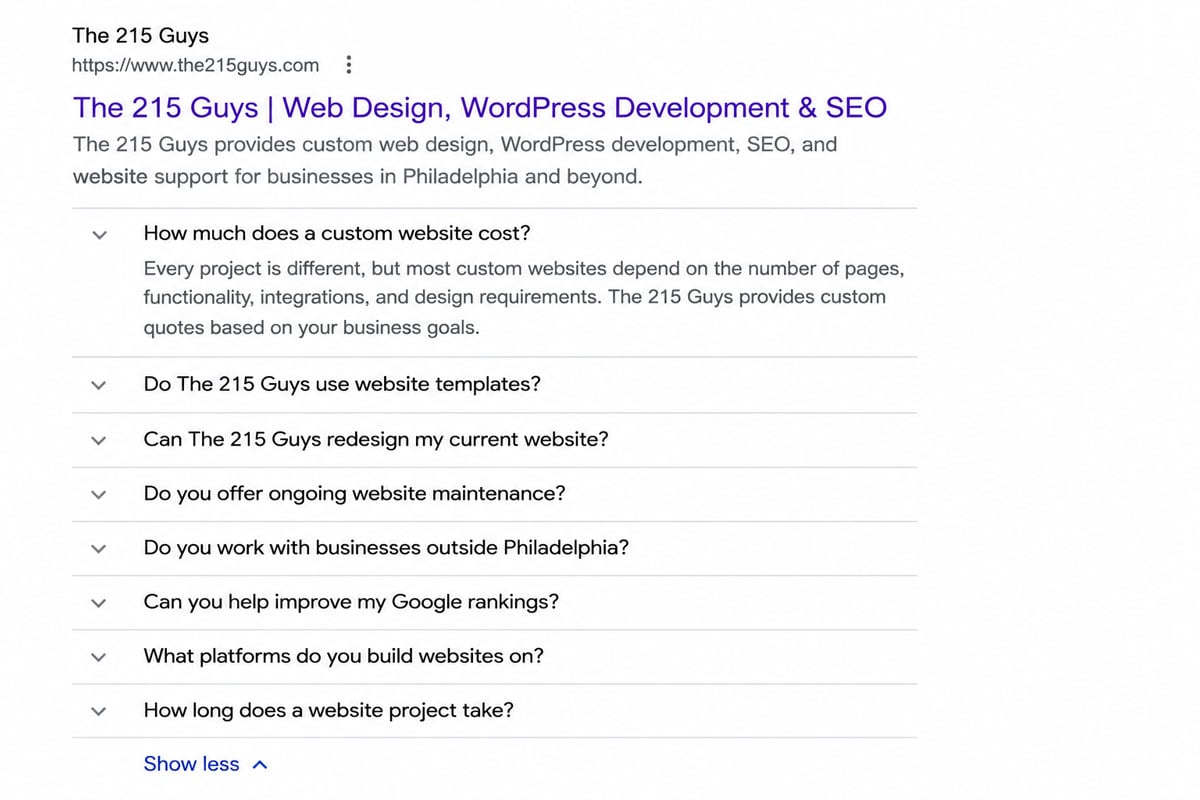
In practice, FAQ rich results were valuable because they gave a page more space in the search results. Taking more SERP real estate is almost always a good thing. When a result had expandable FAQ dropdowns, it could visually stand out, push competitors farther down the page, and sometimes answer enough of the searcher’s question to improve trust before the click.
The impact varied by query and industry. FAQ snippets tended to be most useful on informational pages, service pages, ecommerce category pages, SaaS feature pages, and other pages where users had obvious follow-up questions before making a decision. For example, a local service page with questions about pricing, service areas, timelines, and guarantees could use FAQ rich results to make the listing more useful in the SERP. An ecommerce product page could use FAQs to address shipping, sizing, compatibility, or return questions.
Now, that extra search result space is no longer available through FAQ rich results. So if a page used to rely on FAQ dropdowns to look bigger in search, that advantage is gone. We should not expect FAQPage markup to increase organic visibility by creating dropdowns anymore.
That does not mean the FAQ section on the page stopped mattering. It only means the SERP display benefit stopped mattering because Google removed it.
Do not remove FAQ schema just because the rich result is gone
The biggest mistake I’m seeing in response to this change is overcorrecting. Some site owners want to delete every FAQ section. Others want to remove FAQPage schema across the entire site. I would not do that as a default move.
The recommendation from the expert Q&A is direct: do not remove the schema and still add it in the future. Keeping FAQ schema will not hurt your site. It no longer gives you the old benefit of extra SERP real estate, but it still gives search engines a clearer description of the question-and-answer content on the page.
Structured data is not only about rich results. Rich results are the most visible payoff, but schema can also help define entities, page structure, relationships, and content meaning. FAQPage schema tells crawlers, in a clean format, that a block of content contains questions and direct answers. That can still be useful even if Google no longer displays those questions as dropdowns in traditional search results.
Before making a sitewide change, teams should think about technical and operational risk. Removing markup at scale takes development time, QA time, and reporting updates. It can also create unnecessary deployment risk if templates are shared across different page types. If the markup is valid, accurate, and reflects visible content on the page, there is usually no urgent reason to remove it.
What “focus on quality content” actually means now
After every structured data change, SEO advice tends to collapse into the same phrase: “focus on quality content.” That is true, but it is not specific enough to be useful.
For FAQ content, quality means the questions should solve real user friction. We should not add FAQs just because a template has an FAQ block. We should add them when people genuinely need clarification before they can compare options, make a purchase, book a service, troubleshoot an issue, or understand a policy.
A strong FAQ section usually does a few things well:
- It answers questions users actually ask before converting or continuing their research.
- It gives direct answers instead of vague marketing copy.
- It supports the main purpose of the page instead of drifting into unrelated topics.
- It includes internal links when the user needs a deeper explanation or next step.
- It reduces customer support friction by making common answers easy to find.
For example, on a product page, a useful FAQ might answer whether the product works with a specific model, what is included in the box, how returns work, or how long shipping usually takes. On a legal, medical, or financial page, FAQs may need to clarify eligibility, risks, documentation, or next steps in careful language. On a B2B software page, FAQs may address integrations, implementation time, data migration, support levels, or contract terms.
That kind of content is still valuable because it helps users make decisions. It can also improve engagement, reduce pogo-sticking, support conversions, and create stronger internal linking paths.
Experienced SEOs treat FAQ content as part of the page, not a search trick
Beginners often think of FAQ content as something added at the bottom of a page to win a rich result. Experienced SEOs usually think about it differently. FAQs are a way to match intent more completely.
If someone is searching for a service, they may not only want to know what the service is. They may want to know how much it costs, how long it takes, what is included, who it is right for, what happens next, and whether there are any limitations. If those answers are missing, the page may feel incomplete even if the main body copy is well written.
FAQ sections can also help with conversions. A user who is close to taking action often has one or two final objections. They may be worried about contracts, refunds, setup, compatibility, safety, availability, or support. Answering those questions clearly on the page can reduce hesitation.
Internal linking is another reason FAQ content still deserves attention. If an FAQ answer briefly explains a topic that has its own detailed page, we can link to that deeper resource. This helps users continue their journey and helps search engines understand how related content connects across the site.
Where FAQ content and structured data still deserve extra attention
FAQ content still deserves attention across many site types, even without the dropdown rich result. I would pay especially close attention to FAQs on help centers, ecommerce product pages, regulated industry pages, SaaS pages, local service pages, and pages that support AI search experiences.
Help centers are an obvious case because the entire purpose is to answer specific questions. Ecommerce sites benefit when FAQs reduce uncertainty around sizing, shipping, returns, warranties, and product compatibility. Regulated industries need careful FAQ content because users often need precise answers, and vague copy can create trust issues. Local businesses can use FAQs to clarify pricing, service areas, emergency availability, licensing, and appointment expectations.
There is also a broader structured data point here. FAQ rich results are gone, but other schema types may still be eligible for rich results or other search features. Product, Review, Recipe, Event, Organization, LocalBusiness, BreadcrumbList, VideoObject, and HowTo markup may still matter depending on the page and Google’s current policies. Removing FAQ schema because one visual feature disappeared can lead teams to undervalue structured data as a whole.
The cleaner approach is to keep using structured data when it accurately describes visible page content. Do not mark up content that users cannot see. Do not stuff fake questions onto a page. Do not create FAQ blocks just to satisfy an SEO checklist. But when a page includes genuine question-and-answer content, FAQPage schema can still be included.
How SEO priorities should shift over the next 3 to 6 months
Over the next few months, I would not spend time removing valid FAQ schema. I would spend time auditing whether FAQ content is actually useful.
Start by identifying pages that previously received meaningful visibility from FAQ rich results. Since Search Console reporting for FAQ structured data is being removed in June 2026, teams should preserve any historical data they care about before it disappears. Look at pages where impressions, CTR, or organic clicks changed after May 7, 2026, but be careful not to blame every movement on this update. Rankings, competitors, SERP layouts, AI features, and seasonality can all affect performance.
Then review the FAQ sections themselves. Keep the questions that answer real objections or support the page’s search intent. Rewrite thin answers that do not help. Remove duplicate questions that appear across dozens of pages without a reason. Add internal links where users need more context. Make sure the markup matches the visible content.
The priority is not to chase the old dropdown snippet. That feature is gone. The priority is to make the page more complete, easier to understand, and easier for both users and search systems to interpret.