If your website was built with a vibe coding platform and it uses React by default then that setup makes SEO harder than it needs to be, and in many cases it quietly blocks your site from ranking well at all. Google often does not see your content when it first crawls a React-based site and there's no reason to leave it up to chance.
If you want traffic from search, especially for blog posts, service pages, or local searches, a default React build is working against you unless it’s configured very carefully. Most vibe coding tools do not handle that part for you, which is why these sites look great but struggle to show up in Google.
What Google actually receives when it visits your React site
When you visit your site, your browser runs JavaScript and builds the page for you. Google does not start there. It first requests the raw HTML from the server.
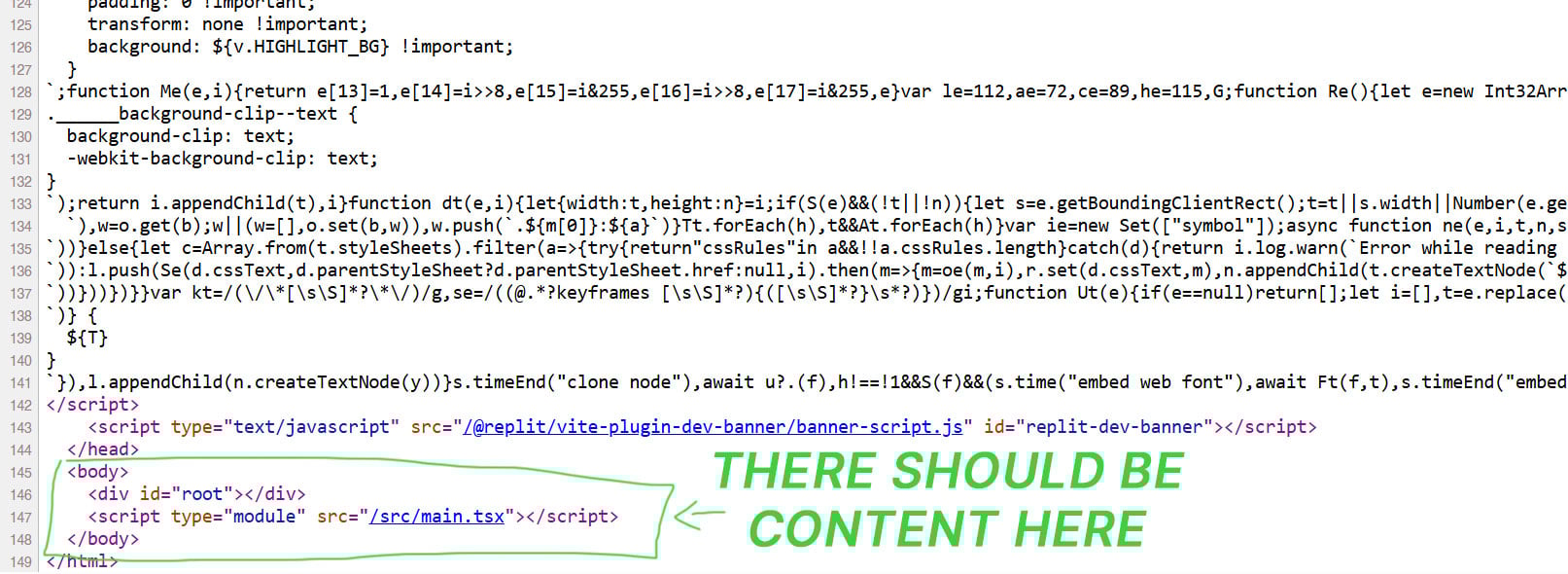
On many vibe-coded React sites, that HTML contains almost no real content. It is mostly a shell plus JavaScript instructions. The actual words, headings, and links are added later.
Google can render JavaScript, but it often does that later, sometimes much later, and sometimes not fully. That delay matters.
To check this on your own site, right click the page and choose “View Page Source.”
Scroll through the source and look for your actual page copy. If you mostly see scripts and very little readable text, Google is starting from the same empty version.
That is the root of the SEO problem.
Here's what a problematic site's source looks like:
Why delayed rendering causes ranking issues in practice
Google prioritizes pages it can understand quickly and confidently. When content shows up late, several things break at once.
Headings might not be processed correctly. Internal links can be missed. Metadata loaded with JavaScript may not be picked up consistently. This makes Google unsure what the page is about.
We have seen this play out repeatedly. One small service business had a React-based site built with an AI tool. Only the homepage indexed. None of the service pages showed impressions. After converting the same content to WordPress with no copy changes, all pages indexed within days.
Same content. Different rendering. Completely different outcome.
Why “Google can index React” is technically true but risky for you
You will hear this a lot, and it is not wrong. Google can index React.
What that statement leaves out is reliability.
Large companies using React invest heavily in server-side rendering, pre-rendering, and SEO infrastructure. They also have strong authority, which encourages Google to spend more crawl resources on them.
Your site does not get that benefit of the doubt. You need Google to understand your pages immediately, not eventually.
If SEO matters to you, “it might work” is not a good foundation.
Why vibe coding tools default to React in the first place
React makes life easier for the tool, not necessarily for your site.
Component-based systems let AI rearrange layouts and regenerate pages quickly. Making everything SEO-safe takes more work, so it is often skipped or simplified.
The tool is optimized for speed and flexibility, not long-term search visibility. If it never asked how important SEO was to you, that decision was already made.
Where this hurts the most: blogs, services, and local pages
Blogs need real URLs, crawlable content, and internal linking that exists without JavaScript. React-based blog systems often treat posts like data entries inside an app, not standalone pages.
Service pages rely on clear structure and fast indexation. Local SEO depends on Google confidently matching page content to location intent. Delayed rendering weakens that connection.
To see if this is affecting you, copy a full sentence from one of your pages and search for it in Google using quotes.
To do this, paste the sentence into Google exactly as written and see if your page appears. If it does not, that page is either not indexed or barely understood.
Why good performance scores don’t fix this
Many React sites score well in PageSpeed or Lighthouse. That feels reassuring, but it does not solve the SEO issue.
Those tools measure how fast content appears after JavaScript runs. Google’s crawl starts before that happens.
You can have a fast, smooth site that Google struggles to index properly.
When React actually is the right choice
If your site is a logged-in app, dashboard, or internal tool, React is fine. SEO is not the main acquisition channel in those cases.
If your site exists to be found through search, especially as a small or growing business, content-first rendering is safer and more predictable.
The problem is not React itself. It is using app architecture for a content problem.
How to improve SEO by prompting vibe coding tools better
Some tools can output static or server-rendered pages if you are very explicit.
You can either ask the tool to make something good for SEO and it will choose the best framework (probably Astro) or prompt the tool to generate fully static HTML pages for each route instead of a single-page app. Ask that all text, headings, and metadata exist in the initial HTML response. Request clean URLs, internal links, and a sitemap.
The reason this helps is simple: it removes uncertainty for Google.
The limitation is that many tools still fall back to React internally, even when they claim static support.
When converting the site makes more sense than fixing prompts
If your site already looks good, conversion is often faster than fighting the framework.
WordPress outputs crawlable HTML by default. Pages exist immediately. Metadata sticks. Internal linking works the way Google expects.
Either force your vibe coding tool to output real HTML pages or move the site to a platform that does this by default. If you want to keep your design and skip the trial and error, converting the site to WordPress through a service like vibetowp.com lets you focus on ranking instead of debugging how your pages load.